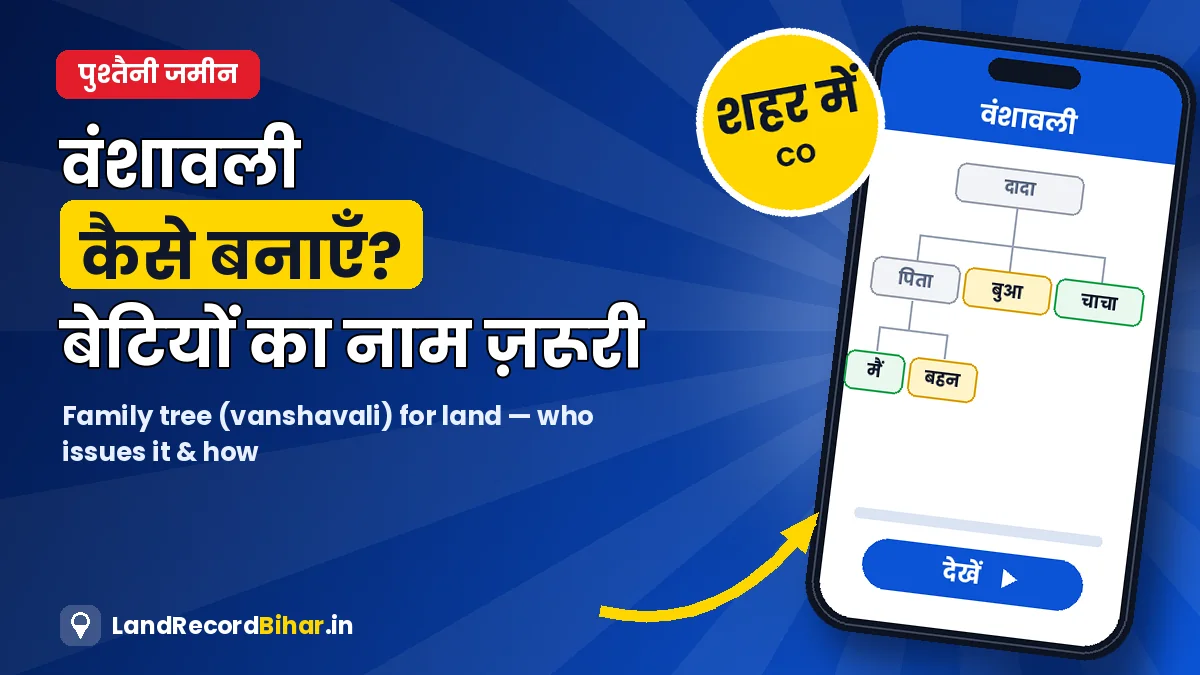
पुश्तैनी जमीन का कोई भी काम — उत्तराधिकार का दाखिल-खारिज, पारिवारिक बँटवारा, विशेष सर्वे में स्वघोषणा या अदालत में हक साबित करना — एक कागज़ के बिना अधूरा है: वंशावली। वंशावली बताती है कि खतियान में दर्ज पूर्वज से आज तक जमीन किन-किन वारिसों तक पहुँची। दिसंबर 2025 से शहरी क्षेत्रों में वंशावली जारी करने की ज़िम्मेदारी अंचलाधिकारी को दी गई है। इस गाइड में वंशावली बनाने का सही तरीका, कौन जारी करता है और आम गलतियाँ समझिए।
वंशावली कहाँ-कहाँ काम आती है
- उत्तराधिकार का दाखिल-खारिज
- पारिवारिक बँटवारा और उसका दाखिल-खारिज
- विशेष भूमि सर्वे में प्रपत्र-3(1)
- मुआवज़ा, एलपीसी या न्यायालय में हक साबित करने में
वंशावली कौन जारी करता है?
ग्रामीण क्षेत्रों में वंशावली परंपरागत रूप से सरपंच द्वारा सत्यापित होती है। शहरी क्षेत्रों — नगर निगम, नगर परिषद और नगर पंचायत — में इसकी स्पष्ट व्यवस्था नहीं थी। राजस्व एवं भूमि सुधार विभाग के 24 दिसंबर 2025 के आदेश से अब शहरी क्षेत्रों में अंचलाधिकारी (CO) वंशावली जारी करने के लिए सक्षम हैं। आवेदन की प्रक्रिया और कागज़ के लिए अपने अंचल कार्यालय से संपर्क करें।
विशेष सर्वे में प्रपत्र-3(1) के रूप में रैयत द्वारा स्वयं घोषित वंशावली दी जाती है। फिर भी परिवार के सभी सदस्यों की सहमति और सही विवरण बहुत ज़रूरी है, क्योंकि ड्राफ्ट प्रकाशन पर कोई भी वारिस आपत्ति कर सकता है।
वंशावली कैसे बनाएँ — चरण-दर-चरण
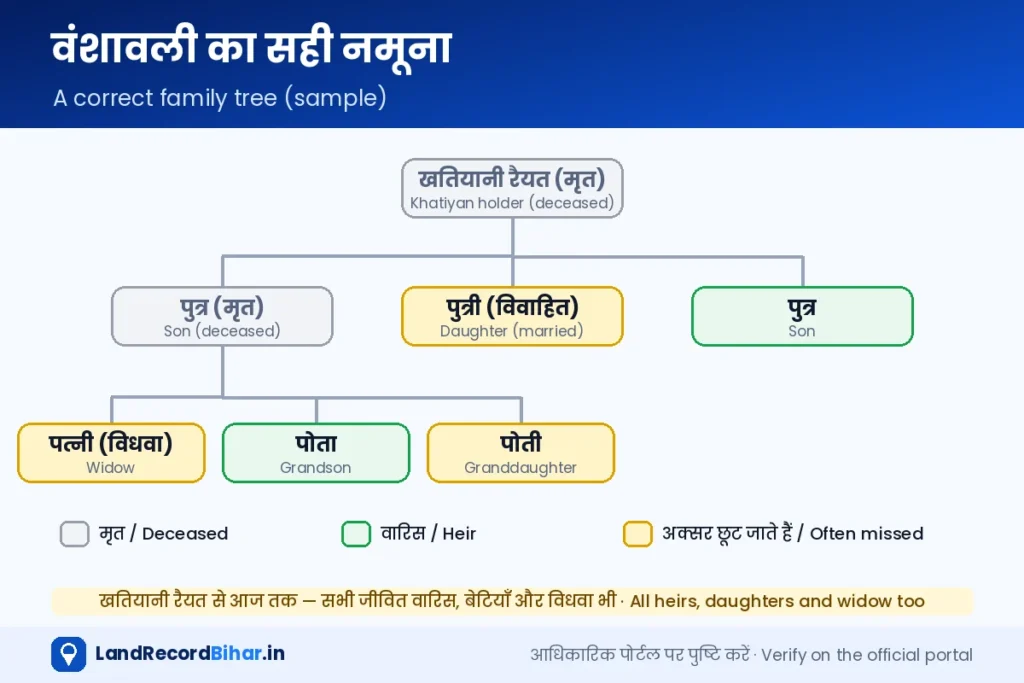
- खतियानी रैयत से शुरू करें: खतियान में जिसका नाम दर्ज है, वही वंशावली की पहली पीढ़ी है। खतियान कैसे निकालें।
- हर पीढ़ी लिखें: बेटे, बेटियाँ, पत्नी/पति — क्रम से, नाम के साथ पिता का नाम।
- मृत सदस्य चिह्नित करें: नाम के साथ “मृत” और संभव हो तो मृत्यु तिथि; मृत्यु प्रमाण पत्र रखें।
- आज के वारिस तक पहुँचें: अंतिम पंक्ति में सभी जीवित वारिस हों।
- सत्यापन: ग्रामीण क्षेत्र में सरपंच, शहरी में अंचलाधिकारी से; सर्वे में प्रपत्र-3(1) पर हस्ताक्षर।
बेटियों का नाम ज़रूर लिखें
हिंदू उत्तराधिकार कानून में 2005 के संशोधन के बाद बेटियों को बेटों के बराबर हक है — शादीशुदा बेटियों को भी। वंशावली से बेटी, बहन या विधवा का नाम छोड़ना आगे चलकर दाखिल-खारिज रद्द होने, आपत्ति या मुकदमे का सबसे आम कारण है। अगर कोई वारिस अपना हिस्सा नहीं लेना चाहता, तो उसका नाम हटाने के बजाय नियमानुसार लिखित सहमति/त्याग-पत्र लें।
वंशावली का सरल नमूना
| पीढ़ी | नाम | संबंध | स्थिति |
|---|---|---|---|
| 1 | रामनाथ सिंह | खतियानी रैयत | मृत |
| 2 | शिवनाथ सिंह | पुत्र | मृत |
| 2 | सुमित्रा देवी | पुत्री | जीवित |
| 3 | अमित कुमार | शिवनाथ के पुत्र | जीवित |
| 3 | प्रिया कुमारी | शिवनाथ की पुत्री | जीवित |
यह केवल समझाने के लिए काल्पनिक उदाहरण है।
साथ रखने वाले कागज़
- मृत सदस्यों के मृत्यु प्रमाण पत्र
- सभी वारिसों के आधार/पहचान पत्र
- खतियान और जमाबंदी की प्रति
- ज़रूरत हो तो शपथ पत्र
अक्सर पूछे जाने वाले प्रश्न
क्या वंशावली के लिए कोई तय फ़ॉर्मेट है?
सर्वे में प्रपत्र-3(1) का फ़ॉर्मेट है। अन्य कामों में सरपंच/अंचल कार्यालय का प्रचलित प्रारूप इस्तेमाल होता है — कार्यालय से नमूना लें।
परिवार में विवाद हो तो?
वंशावली पर सहमति न बने तो दाखिल-खारिज में आपत्ति आएगी। ऐसे मामलों में राजस्व न्यायालय या दीवानी न्यायालय का रास्ता है; अधिवक्ता से सलाह लें।
निष्कर्ष: सही वंशावली पुश्तैनी जमीन के हर काम की नींव है। खतियानी रैयत से शुरू करें, हर वारिस — खासकर बेटियाँ — शामिल करें, मृत्यु प्रमाण पत्र साथ रखें और सही अधिकारी से सत्यापन कराएँ।
Any work on ancestral land — inheritance mutation, family partition, the special-survey self-declaration or proving title in court — needs one paper: the vanshavali (family tree). It shows how land passed from the ancestor named in the khatiyan to today’s heirs. Since December 2025, Circle Officers issue vanshavali in urban areas. This guide covers how to prepare it correctly, who issues it and the common mistakes.
Where a vanshavali is used
- Inheritance mutation
- Family partition and its mutation
- Prapatra-3(1) in the special land survey
- Compensation, LPC or proving title in court
Who issues it?
In rural areas the vanshavali is traditionally attested by the sarpanch. Urban areas — municipal corporations, councils and nagar panchayats — had no clear system. Under the Revenue & Land Reforms Department’s order of 24 December 2025, Circle Officers are now competent to issue vanshavali in urban areas. Ask your circle office about the application and papers.
In the special survey the family tree is given by the raiyat as a self-declaration in Prapatra-3(1). Even so, every family member’s agreement and correct details matter — any heir can object at the draft stage.
Preparing a vanshavali — step by step
- Start with the khatiyan holder: the person named in the khatiyan is generation one. See how to get the khatiyan.
- Write each generation: sons, daughters, spouse — in order, with father’s name.
- Mark the deceased: write “deceased” and the date if possible; keep death certificates.
- Reach today’s heirs: the last row must list every living heir.
- Get it attested: by the sarpanch in rural areas or the Circle Officer in urban areas; sign Prapatra-3(1) for the survey.
Always include daughters
Since the 2005 amendment to Hindu succession law, daughters have the same rights as sons — married daughters included. Leaving out a daughter, sister or widow is the most common reason for objections, cancelled mutations and lawsuits. If an heir doesn’t want a share, take a proper written consent/relinquishment instead of dropping the name.
A simple sample
| Generation | Name | Relation | Status |
|---|---|---|---|
| 1 | Ramnath Singh | Khatiyan holder | Deceased |
| 2 | Shivnath Singh | Son | Deceased |
| 2 | Sumitra Devi | Daughter | Living |
| 3 | Amit Kumar | Shivnath’s son | Living |
| 3 | Priya Kumari | Shivnath’s daughter | Living |
A fictional example for illustration only.
Papers to keep with it
- Death certificates of deceased members
- Aadhaar/ID of every heir
- Copies of the khatiyan and jamabandi
- An affidavit if required
FAQs
Is there a fixed format?
The survey uses Prapatra-3(1). For other work, the format used by the sarpanch/circle office applies — ask for a sample.
What if the family disagrees?
Without agreement on the tree, mutation will face objections. Such cases go to the revenue or civil court; consult an advocate.
Bottom line: a correct vanshavali is the foundation of all ancestral-land work. Start from the khatiyan holder, include every heir — daughters especially — keep death certificates and get it attested by the right authority.